DOR YESHORIM, BY THE NUMBERS
In the past three months: July – September 2026
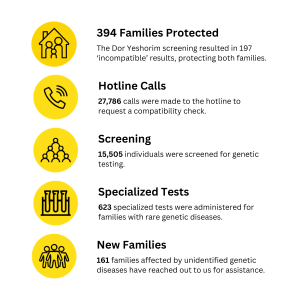
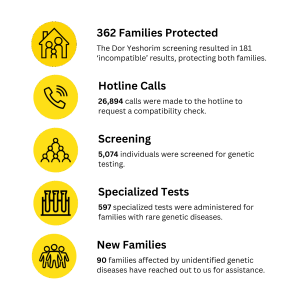
- 4,502 individuals were screened for pre-marital genetic testing.
- 14,071 potential couples (28,142 individuals) called the hotline to request a
compatibility check. - 219 compatibility requests resulted in ‘incompatible’, and genetic counseling was
offered to those individuals and their families (see chart below). - 562 specialized tests were administered for families with rare genetic diseases.
- 102 new families suffering from yet-to-be-identified genetic diseases reached out to Dor
Yeshorim for assistance. Dor Yeshorim is working to meet their needs.
The 219 incompatible results saved families from the following genetic diseases:
| Standard Panel | |
| Aicardi-Goutières Syndrome Type 5 (SAMHD1-Related) | 2 |
| Autosomal Recessive Polycystic Kidney Disease (ARPKD, PKHD1-Related) | 3 |
| Bardet-Biedl Syndrome Type 2 (BBS2-Related) | 1 |
| Bloom Syndrome (BLM-Related) | 1 |
| Congenital Amegakaryocytic Thrombocytopenia (CAMT) | 1 |
| Congenital Disorder of Glycosylation (SLC35A3-CDG) | 1 |
| Canavan Disease (ASPA-Related) | 5 |
| Congenital Heart Defects and Other Structural Anomalies (GDF1-Related) | 4 |
| Congenital Diarrheal Disorder (DGAT1-Related) | 1 |
| Carnitine Palmitoyltransferase II Deficiency | 1 |
| Cystic Fibrosis (CFTR-Related) | 25 |
| Classic Galactosemia (GALT-Related) | 3 |
| Dermatosparaxis Ehlers-Danlos Syndrome (ADAMTS2-Related) | 1 |
| Dihydrolipoamide Dehydrogenase Deficiency (Lipoamide Dehydrogenase Deficiency) | 6 |
| Dyskeratosis Congenita, Autosomal Recessive Type 5 (RTEL1-Related) | 1 |
| Familial Dysautonomia (Riley-Day Syndrome, ELP1-Related) | 13 |
| Fanconi Anemia Complementation Group C (FANCC) | 1 |
| Familial Hyperinsulinism (Congenital Hyperinsulinism, ABCC8-Related) | 4 |
| Glycogen Storage Disease Type Ia (von Gierke Disease) | 5 |
| Homocystinuria due to Cystathionine Beta-Synthase Deficiency | 1 |
| Hypomyelinating Leukodystrophy (VPS11-Related) | 1 |
| Leigh Syndrome (NDUFAF5-Related) | 1 |
| MEPAN Syndrome (Mitochondrial Enoyl-CoA Reductase Protein-Associated Neurodegeneration) | 1 |
| Maple Syrup Urine Disease (MSUD) | 1 |
| Mitochondrial Complex V Deficiency, Nuclear Type 6 (USMG5-Related) | 3 |
| Multiple Sulfatase Deficiency | 1 |
| Nemaline Myopathy Type 2 (NEB-Related) | 1 |
| Niemann-Pick Disease Type A/B (SMPD1-Related) | 1 |
| Primary Coenzyme Q10 Deficiency Type 7 (COQ4-Related) | 1 |
| Retinitis Pigmentosa 59 (DHDDS-Related) | 5 |
| Smith-Lemli-Opitz Syndrome (DHCR7-Related) | 10 |
| Spastic Tetraplegia, Thin Corpus Callosum, and Progressive Microcephaly (SLC1A4-Related) | 1 |
| Spinal Muscular Atrophy | 2 |
| Tay-Sachs Disease (HEXA-Related) | 18 |
| Usher Syndrome Type 1F (PCDH15-Related) | 1 |
| Ventriculomegaly with Cystic Kidney Disease (CRB2-Related) | 4 |
| Walker-Warburg Syndrome (FKTN-Related) | 5 |
| Warsaw Breakage Syndrome (DDX11-Related) | 3 |
| Wilson Disease (ATP7B-Related) | 4 |
| Wolfram Syndrome 1 | 8 |
| 3MC Syndrome (COLEC10-Related) | 3 |
| Hearing Loss Panel | |
| Autosomal Recessive Nonsyndromic Hearing Loss (DFNB16/STRC) | 8 |
| Autosomal Recessive Nonsyndromic Hearing Loss (DFNB18B/OTOG) | 1 |
| Autosomal Recessive Nonsyndromic Hearing Loss (DFNB1/GJB2) | 34 |
| Autosomal Recessive Nonsyndromic Hearing Loss (DFNB3/MYO15A) | 1 |
| Autosomal Recessive Nonsyndromic Hearing Loss (DFNB7/11/TMC1) | 1 |
| Autosomal Recessive Nonsyndromic Hearing Loss (DFNB77/LOXHD1) | 1 |
| Autosomal Recessive Nonsyndromic Hearing Loss (DFNB9/OTOF) | 2 |
| Neurodevelopmental Disorder with Hearing Loss (SPATA5L1-Related) | 2 |
| Usher Syndrome Type 1C (USH1C-Related) | 1 |
| Usher Syndrome Type 3A (CLRN1-Related) | 1 |
| Specialiazed Testing* | |
| Fanconi Anemia Complementation Group A (FANCA) | 2 |
| Friedreich Ataxia | 2 |
| Gaucher Disease | 3 |
| Intellectual Disability and Behavioral Delay (SGSM3-Related) | 2 |
| Ullrich Congenital Muscular Dystrophy Type 1 (COL6A-Related) | 1 |
| Usher Syndrome Type 2A (USH2A-Related) | 1 |
| Very Long-Chain Acyl-CoA Dehydrogenase Deficiency (VLCAD Deficiency) | 1 |
| Total | 219 |
*These tests are not yet included in the standard testing panel. They were requested by families currently suffering from the aforementioned diseases to assist with shidduchim and prevent the birth of children with these diseases.
Further funding will allow the standard testing panel to include more of these debilitating diseases.
Statistically Speaking:
167 incompatible matches for debilitating diseases = 334 individuals.
This translates into 167 men and 167 women who will Be”H not face the heartache of children born with recessive, debilitating genetic diseases.
52 incompatibles for Hearing Loss = 104 individuals
This translates into 52 men and 52 women being informed that they face the possibility of
children born with hearing loss.